
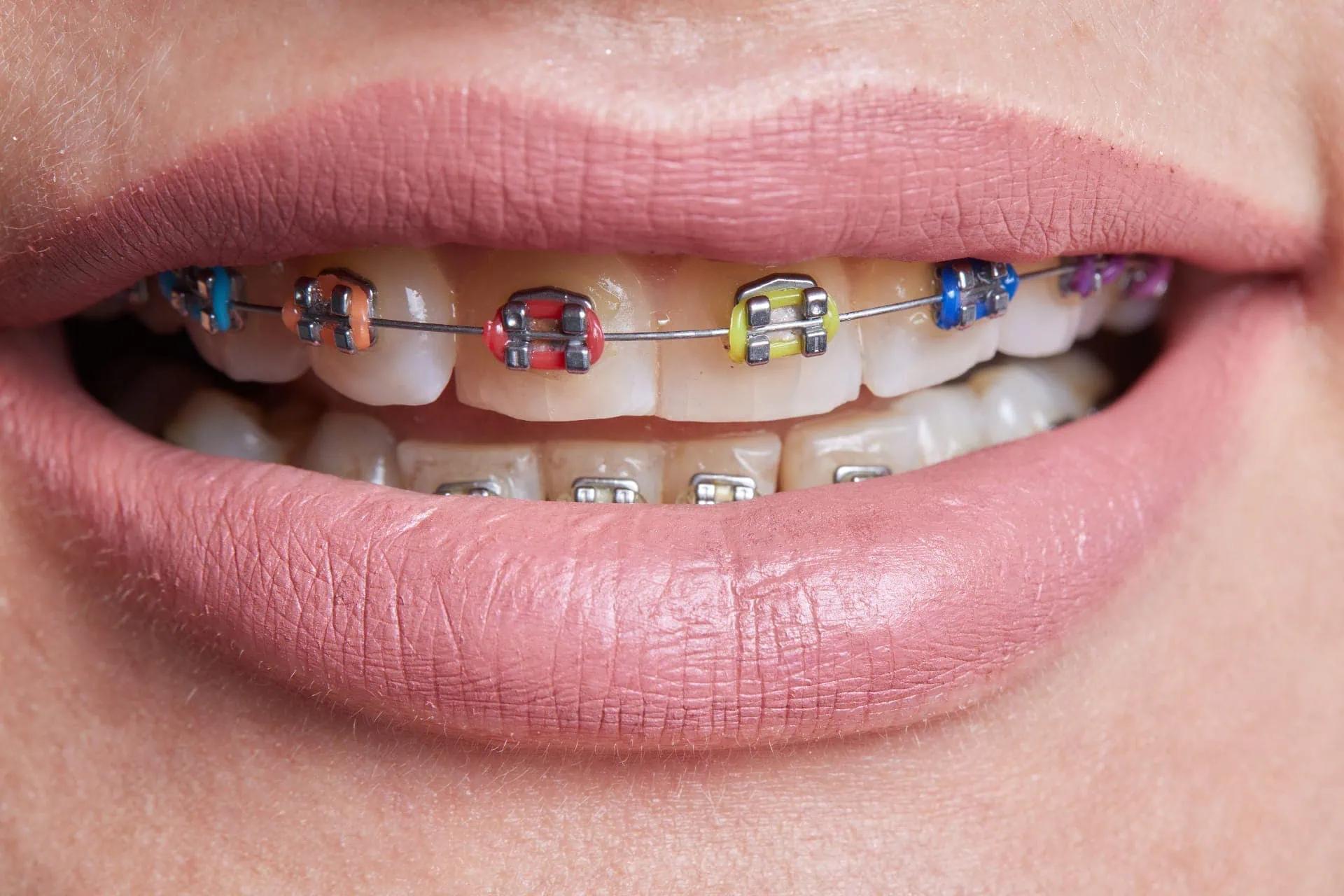
Power chains on braces are connected elastic O-rings that link your brackets together in a continuous strip, applying steady force to close gaps and move teeth into alignment. Unlike individual ligatures that wrap around each bracket separately, power chains stretch across multiple teeth to deliver even, consistent pressure that pulls them closer together. They’re one of the most commonly used tools in orthodontic treatment, and your orthodontist will let you know if and when they make sense for your specific case.
Regular ligatures each handle one bracket on their own. Power chains link up across several brackets, so they pull as a group. This connected design makes them especially effective for closing spaces and bringing your smile together. If your orthodontist mentions adding power chains during your next visit, there’s no reason to stress. They’re a routine part of braces treatment that many people wear at some point.
Power chains come in three main types based on spacing:
- Closed power chains: Rings connect at every link with no gaps between them, providing maximum force for closing spaces
- Short power chains: One empty ring space between connection points, offering moderate force
- Long power chains: Two empty ring spaces between connections, providing gentler force for specific movements
Made from the same stretchy elastic material as standard ligatures, power chains also come in a rainbow of colors. Want to match your school colors or show off your personality? You can choose from options like blue, purple, pink, or even go subtle with clear or silver. Get custom treatment with your style in mind, right down to the details. Clear and tooth-colored options are popular with people who want a more low-key look, while bolder shades let you have fun with your braces.
How Do Power Chains Work to Move Your Teeth?
Power chains work by distributing continuous elastic force across multiple brackets, creating tension that pulls teeth toward each other and encouraging bone remodeling around your tooth roots. As your teeth shift, the bone tissue on one side breaks down while new bone forms on the other side. This biological process, called bone remodeling, is what allows teeth to move permanently into new positions. The steady pressure from power chains keeps this cycle going between visits.
Here’s what happens when you get them placed:
Your orthodontist removes your existing ligatures and evaluates which type of power chain fits your goals. After selecting the right one, they stretch it across the brackets that need to move closer together. That elastic tension does the heavy lifting from there, steadily drawing those teeth into alignment over the following weeks. The whole process takes just a few minutes during your regular visit.
The spacing your orthodontist chooses matters a lot. Need to close an extraction site? Closed versions apply the strongest force and work well for that. For fine-tuning tooth positions or working on teeth that need slower movement, short or long versions dial back the pressure. Your board-certified orthodontist selects the right type based on the force level your teeth need at that stage.
One thing worth knowing: power chains lose their stretch over time. The elastic material gradually weakens, which is exactly why your orthodontist replaces them every 4 to 6 weeks during your regular adjustment visits. Fresh ones mean consistent force throughout your time in braces. Without that replacement cycle, the force would taper off and slow your progress.
How long will you wear power chains? That depends on what your teeth need to accomplish. Some people wear them for just 6 weeks to close a small gap. Others might have them for 6 months or longer for more complex spacing issues. Your orthodontist will give you a timeline based on your specific situation and track your progress at every visit.
Benefits of Power Chains on Braces
So why do orthodontists reach for power chains so often? A few big reasons.
What Gaps Can Power Chains Close?
Gaps from tooth extractions, naturally occurring spaces between teeth, or a diastema (the gap between your two front teeth), power chains handle all of these. They’re especially popular for pulling neighboring teeth together after a tooth has been removed. Instead of working on one tooth at a time, power chains distribute force across multiple teeth at once for more uniform movement. According to the American Association of Orthodontists, spacing issues are among the top reasons people seek braces treatment, and power chains are one of the most effective tools for addressing them.
How Do Power Chains Help with Alignment and Rotation?
Teeth that have twisted out of position can be guided back into proper alignment with power chains. They also help correct your midline, which is the center point where your upper and lower teeth should line up. When that center is off, power chains can shift things into balance.
For certain tooth movements, power chains may close gaps more quickly than individual ligatures on their own, depending on your case. The continuous pulling force is particularly useful for rotated teeth because it maintains constant pressure rather than relying on a single point of contact. This makes the correction more predictable and, in many cases, faster.
Power Chains vs. Regular Elastic Ligatures: What’s the Difference?
Understanding the difference between these two options helps you know what to expect during your time in braces.
| Feature | Power Chains | Regular Elastic Ligatures |
|---|---|---|
| Structure | Connected rings forming a continuous strip | Individual O-rings, one per bracket |
| Force Application | Continuous pressure across multiple teeth | Isolated force on each individual tooth |
| Primary Purpose | Closing gaps, moving groups of teeth together | Holding archwire in place on each bracket |
| Replacement Frequency | Every 4-6 weeks (loses elasticity faster) | Every 4-8 weeks |
| Initial Soreness | May cause more discomfort due to added force | Generally milder adjustment period |
| Color Options | Available in many colors including clear | Wide variety of colors available |
Your orthodontist chooses between these options based on your current phase. Early on, individual ligatures often handle the job of holding your archwire while your teeth begin their initial movements. As things progress and gap closure becomes the priority, power chains step in to finish the job.
Some people have both at the same time. You might have power chains on your front teeth to close a gap while individual ligatures remain on your back teeth. It all depends on what each section of your smile needs.
Do Power Chains Cost Extra? Understanding Pricing
Power chains are typically included in your overall braces cost at no extra charge. Most orthodontic practices consider them a standard part of treatment, not an add-on service, so you won’t see a separate line item for power chains on your bill.
Your total braces investment varies based on several factors: the complexity of your case, how long your braces process takes, and the type of braces you choose. Some studios offer all-inclusive pricing that covers every adjustment, replacement, and tool used from start to finish. Many also accept insurance and offer flexible payment options, including 0% interest plans, to help you budget for treatment.
During your initial free consult, ask what’s included in your quoted price. That way you’ll know exactly what’s covered, power chains and all. No surprises. Having that clarity from the start makes the whole experience easier to plan for.
Who Needs Power Chains? Common Reasons Your Orthodontist May Recommend Them
Not everyone with braces will need power chains. Your orthodontist recommends them when your teeth require specific types of movement that benefit from continuous force. Some people get them early in treatment, others later, and some never need them at all. Here’s a breakdown of the most common reasons.
Common reasons you might get power chains:
- Extraction site closure: Had teeth removed to create space? Power chains help close those gaps by pulling neighboring teeth together over time. These are some of the larger spaces orthodontists need to close, so power chains often stay on longer in these cases.
- Natural spacing (diastema): Some people have gaps between teeth that developed naturally, especially between the front two teeth. Power chains can eliminate these spaces effectively.
- Post-leveling alignment: Once your teeth have been straightened in the initial phase, power chains bring everything together uniformly so there are no leftover spaces. This is often one of the final steps before your braces come off.
- Midline correction: When the center of your upper teeth doesn’t line up with your lower teeth, power chains can shift things into proper alignment.
- Rotation correction: Twisted or rotated teeth respond well to the continuous pulling force that power chains provide, guiding them back into place gradually.
Your orthodontist evaluates your progress at each visit and decides when power chains will be most effective. Trust your board-certified orthodontist to make the call based on what your smile needs and your customized plan.
Frequently Asked Questions About Power Chains on Braces
Do power chains hurt more than regular braces?
Yes, power chains may cause some soreness for the first 2 to 3 days, since they apply added force to move your teeth. The discomfort is similar to what you felt when you first got braces or after adjustments. OTC meds like ibuprofen, cold foods, and soft foods can help ease the soreness, and most people find it fades quickly.
How long do you have to wear power chains?
Anywhere from 6 weeks to 6 months, depending on how much movement your teeth need. Small gaps might close in just a few weeks, while larger spaces from extractions take longer. Your orthodontist will give you an estimate and track your progress at each visit.
Can power chains stain?
They can, yes. Dark-colored foods and drinks like coffee, tea, red sauces, curry, and berries tend to discolor them. If you choose lighter-colored or clear power chains, staining becomes more noticeable. Rinsing your mouth after eating helps minimize discoloration. The good news? Your orthodontist replaces them every few weeks, so any staining is temporary.
Can you eat normally with power chains?
Mostly, yes, but you should follow the same food guidelines as regular braces. Avoid hard, crunchy, sticky, and chewy foods that could damage your brackets or get caught in your power chains. Good choices include soft fruits, cooked vegetables, pasta, yogurt, and tender proteins. Basically, if it was off-limits before power chains, it’s still off-limits.
Do power chains work with clear braces?
Power chains come in clear and tooth-colored options that blend in with ceramic or clear brackets. While they may not be completely invisible, they’re much less noticeable than colored ones. Ask your orthodontist about the clear options available if aesthetics matter to you.
How often are power chains replaced?
Every 4 to 6 weeks during your regular adjustment visits. Because the elastic material loses its stretch over time, fresh ones keep consistent force on your teeth. Your orthodontist handles this during your normal visits, so no extra trip is needed. It’s a quick swap that only takes a couple of minutes.