
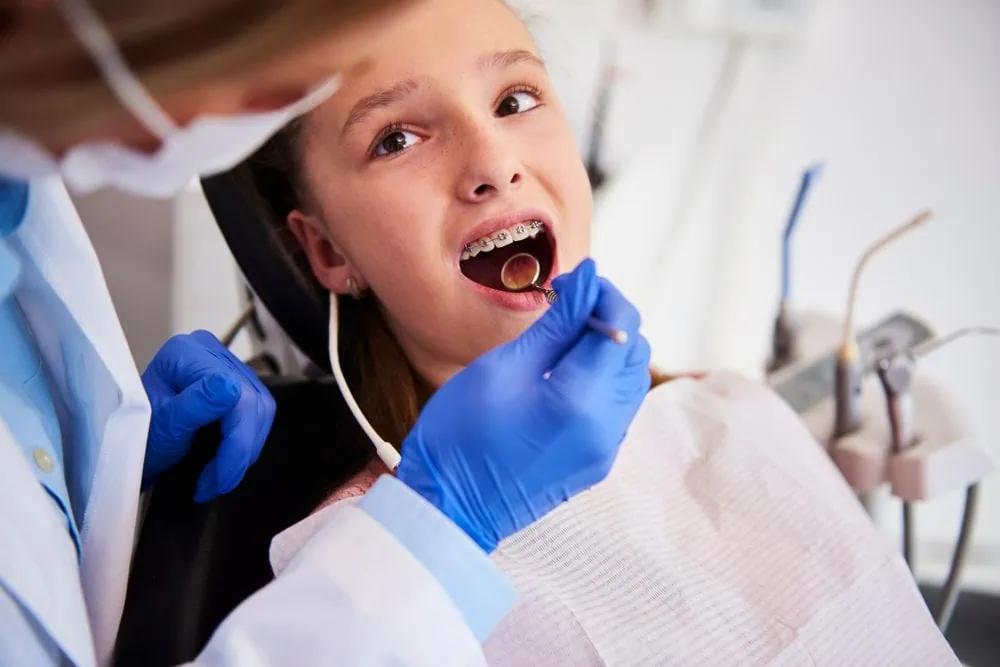
What Is a Crossbite?
A crossbite is a type of malocclusion where one or more upper teeth bite inside the lower teeth instead of resting on the outside. This misalignment can affect the front teeth (anterior crossbite) or the back teeth (posterior crossbite) and may involve a single tooth or an entire section of your bite.
Your upper teeth should fit slightly over your lower teeth, similar to a lid on a box. When that relationship is reversed in specific areas, you have a crossbite. The condition is relatively common, and research published in orthodontic literature estimates crossbite prevalence ranges from roughly 4% to 23% of the population, depending on the age group studied.
There are two main types. An anterior crossbite affects the front teeth, causing upper incisors to sit behind the lower ones when you bite down. A posterior crossbite involves the back teeth, where upper molars or premolars tuck inside the lower teeth on one or both sides.
Crossbites develop for several reasons:
- Genetics: jaw size and tooth positioning often run in families
- Prolonged thumb sucking or pacifier use: these habits can alter jaw development during childhood
- Delayed loss of baby teeth: when primary teeth hang on too long, permanent teeth may erupt in the wrong position
- Jaw size mismatch: this happens when the upper jaw is narrower than the lower jaw
How is a crossbite different from an underbite? An underbite occurs when the entire lower jaw protrudes forward, causing all the lower front teeth to sit in front of the upper teeth. A crossbite is more localized and involves specific teeth or sections of the bite.
How Crossbite Treatment Works: Options for Every Age
The right crossbite treatment depends on your age, the severity of the problem, and whether the issue is dental (involving teeth only) or skeletal (involving jaw structure). Orthodontic specialists at Imagine Orthodontic Studio evaluate each of these factors before recommending a customized plan. Here’s how correction works at different life stages.
How Do Palatal Expanders Work for Children?
For kids whose growth plates haven’t fused yet (typically under 14), a palatal expander is often the most effective crossbite treatment for posterior misalignment. This device attaches to the upper molars and gradually widens the upper jaw over several months. Because children’s bones are still developing, the expansion creates permanent changes in jaw width. Parents turn a small key daily to activate the expander, and most kids adjust quickly with minimal discomfort.
Can Braces Fix a Crossbite at Any Age?
Traditional braces remain one of the most effective tools for crossbite correction. Metal or ceramic brackets bonded to teeth give your orthodontist precise control over tooth movement and bite alignment. Braces handle both anterior and posterior crossbites and work well at any age.
Are Clear Aligners Effective for Crossbites?
Angel Aligners can treat mild to moderate crossbites in teens and adults who commit to wearing their trays consistently. Aligners work by applying gentle, targeted pressure to shift teeth into proper alignment. They’re removable, virtually invisible, and don’t require dietary restrictions.
What Is Two-Phase Orthodontic Treatment?
Some children benefit from a two-phase approach. Phase one addresses jaw growth issues early (often around ages 7 to 10), using expanders or partial braces. After a resting period, phase two refines tooth alignment during the teenage years. This early orthodontic treatment approach can prevent more involved correction later on.
When Is Surgical Correction Needed for a Crossbite?
For adults with severe skeletal crossbites, jaw surgery combined with orthodontics may be necessary. When the jaw bones have fully fused, expansion alone can’t create the structural changes needed. Surgical intervention repositions the jaw, and orthodontic treatment fine-tunes the bite afterward. Recovery takes several weeks, and the results can be life-changing.
Why Fixing a Crossbite Matters: Benefits of Treatment
Crossbite treatment isn’t just about aesthetics. Leaving a crossbite untreated can lead to progressive dental problems and real discomfort. Here’s what correction accomplishes.
How Does a Crossbite Damage Your Teeth?
Misaligned teeth grind against each other unevenly, which causes accelerated enamel wear over time. Correction distributes biting forces properly, protecting your teeth from chips, cracks, and premature breakdown.
Teeth stuck in crossbite also experience abnormal pressure that can damage supporting bone and gum tissue, sometimes leading to gum recession that’s difficult to reverse. Proper bite alignment makes eating easier, too. You can chew efficiently without compensating for teeth that don’t meet correctly, and anterior crossbites sometimes affect pronunciation, so correction can improve speech clarity.
Can a Crossbite Cause Jaw Pain and Headaches?
Yes, and this is one of the most common reasons adults seek crossbite treatment. Crossbites force your jaw to shift when you close your mouth, straining the temporomandibular joint (TMJ). Many people find relief from chronic jaw tension and headaches after correction.
Posterior crossbites can also cause the jaw to shift to one side over time, creating visible facial asymmetry. Treatment restores balance and can make a noticeable difference in how your face looks at rest. A Board-Certified Orthodontist at Imagine Orthodontic Studio can assess how a crossbite is affecting your oral health and recommend the right path forward.
According to the American Association of Orthodontists, untreated bite problems tend to worsen over time rather than improve on their own.
Crossbite Treatment Options Compared: Braces vs. Aligners vs. Expanders
Choosing the right crossbite treatment path depends on several factors. This comparison breaks down your options:
| Treatment Method | Best For | Typical Timeline | Severity Level |
|---|---|---|---|
| Palatal Expander | Children under 14 with skeletal crossbites | 3 to 6 months of active expansion, followed by stabilization | Moderate to severe |
| Traditional Braces | All ages; dental and skeletal crossbites | 12 to 24 months | Mild to severe |
| Angel Aligners | Compliant teens and adults | 6 to 18 months | Mild to moderate |
| Surgical + Orthodontics | Adults with severe skeletal discrepancies | 12 to 18 months orthodontics plus surgical recovery | Severe |
Braces
Braces offer the most versatility. They handle complex tooth movements and work regardless of how compliant you are. Modern braces are smaller and more comfortable than older versions, with options in metal, ceramic, or even gold.
Angel Aligners
People who want a discreet treatment experience often gravitate toward Angel Aligners. They’re effective for many crossbite cases, but success depends on wearing aligners nearly all day and night. The team at Imagine Orthodontic Studio will determine if your crossbite is a good fit for aligner therapy.
Palatal Expanders
Palatal expanders are uniquely effective for children because they address the root cause of many posterior crossbites: a narrow upper jaw. This crossbite treatment takes advantage of natural growth to create lasting changes.
Surgical Correction
Surgical correction sounds intimidating, but it’s a well-established option for adults whose skeletal structure can’t be modified through orthodontics alone. The difference in bite and facial balance is significant, and most adults find recovery manageable.
What Affects the Cost of Crossbite Treatment?
Crossbite treatment costs depend on severity, treatment type, and insurance coverage. A single-tooth crossbite typically requires a smaller investment than a full-arch posterior crossbite involving jaw expansion, and whether you need braces, aligners, or surgery also plays a role.
Severity and complexity: The more teeth involved and the more significant the skeletal component, the more involved your customized plan becomes. Skeletal crossbites generally require more time and resources than dental-only cases.
Treatment type: Palatal expanders and braces typically fall into different price ranges than clear aligners or surgical options. Your orthodontist will recommend the most effective approach for your specific situation.
Insurance coverage: Many dental insurance plans cover crossbite treatment, especially when it’s classified as medically necessary rather than purely cosmetic. Crossbites that cause functional problems often qualify for coverage.
Payment flexibility: Imagine Orthodontic Studio offers 0% interest payment plans to make treatment accessible. Customizable financial arrangements help families budget for care without delaying needed crossbite treatment.
To get a clear picture of your investment, schedule a free consult. Your Board-Certified Orthodontist will evaluate your bite, discuss options, and provide a personalized cost estimate based on your unique needs.
Who Needs Crossbite Treatment? Signs You or Your Child May Be a Candidate
You may need crossbite treatment if you notice jaw shifting, uneven tooth wear, or facial asymmetry. A Board-Certified Orthodontist can identify these issues during a thorough evaluation and recommend the best course of action for your age and situation.
The American Association of Orthodontists recommends that all children receive an orthodontic evaluation by age 7. At this age, enough permanent teeth have erupted to identify developing bite problems, and early intervention can guide jaw growth before it becomes more difficult to correct.
Signs of a crossbite in children include:
- Jaw shifting to one side when biting down
- Visible asymmetry in the face or smile
- Complaints of jaw discomfort or difficulty chewing
- Uneven tooth wear on baby or permanent teeth
Adults with untreated crossbites may notice:
- Chronic jaw discomfort or clicking sounds when opening and closing the mouth
- Worn, chipped, or cracked teeth, sometimes alongside receding gums on certain teeth
- Facial asymmetry that has developed gradually over the years
- Difficulty biting into food cleanly
It’s never too late to correct a crossbite. While early treatment in children can prevent complications and sometimes avoid surgery, adults achieve excellent results too. Modern orthodontic techniques make crossbite treatment possible at any age.
During your visit at Imagine Orthodontic Studio, the team will take X-rays, photographs, and possibly digital scans to assess your bite and jaw structure before recommending a customized plan.
Frequently Asked Questions About Crossbite Treatment
Can a crossbite fix itself?
No. Crossbites do not self-correct and typically worsen over time. As you continue to bite and chew with misaligned teeth, wear patterns become more pronounced, and compensatory jaw movements can lead to TMJ problems.
How long does crossbite treatment take?
It depends on the method and severity. A single-tooth crossbite treated with aligners might resolve in 6 to 12 months, while a skeletal crossbite requiring expansion and braces could take 18 to 24 months. Your orthodontist at Imagine Orthodontic Studio will provide a timeline specific to your case.
Does fixing a crossbite hurt?
Expect mild pressure and soreness, especially after adjustments or when starting new aligner trays. This discomfort is temporary and manageable with over-the-counter pain relievers. Most people describe it as “pressure” rather than anything sharp, and it fades within a few days.
Can clear aligners fix a crossbite?
Angel Aligners effectively treat mild to moderate crossbites when worn consistently. Severe skeletal crossbites or complex cases may require braces or expanders. The team at Imagine Orthodontic Studio will determine if aligners are right for your situation during your free consult.
What happens if you don’t fix a crossbite?
Untreated crossbites cause accelerated enamel wear and increase your risk of chipped or cracked teeth. Over time, you may develop TMJ dysfunction, chronic headaches, and gum recession. Facial asymmetry can also worsen, and the longer you wait, the more complex crossbite treatment becomes.
If you or your child might need crossbite treatment, a professional evaluation is the best first step. The team at Imagine Orthodontic Studio includes Board-Certified Orthodontists who specialize in bite correction for all ages, and a free consult is the best way to find out which option fits your needs. So let’s do this!