
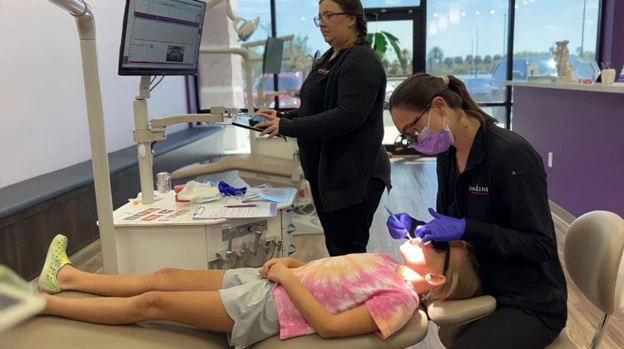
If your orthodontist mentioned IPR during your initial consult, you might be wondering what it involves and whether it hurts. Here’s the thing: IPR is a quick, comfortable technique that’s been helping people get better results from their braces and aligner plans for decades. At Imagine Orthodontic Studio, Board-Certified Orthodontists use IPR regularly to help create the space your teeth need to align properly.
Interproximal reduction (IPR) is the controlled removal of tiny amounts of enamel from between your teeth, sometimes called tooth slenderizing or enamel reduction. The goal is to create just enough space for your teeth to shift into their ideal positions, typically between 0.1 and 0.5 millimeters per contact surface, which is thinner than a credit card.
Your teeth have enamel to spare, and this minimal reduction stays safely within normal limits. That’s why IPR has been a trusted part of orthodontics for so long. It’s not new or experimental. It’s a routine, conservative technique used by Board-Certified Orthodontists to resolve crowding without removing teeth entirely. IPR works well with both traditional braces and clear aligners, making it a versatile tool in your customized plan. Whether you’re a teen just starting out or an adult looking to upgrade your smile, IPR may play a role in getting you the results you’re after.
How Does IPR Work? The Step-by-Step Process
Knowing what happens during IPR can ease any concerns. Here’s what to expect when a Board-Certified Orthodontist at Imagine Orthodontic Studio performs the process:
- Planning and evaluation. Your orthodontist examines your teeth and uses digital imaging to determine exactly where space is needed. They calculate precise reduction amounts for each contact point, often down to fractions of a millimeter. Nothing is left to guesswork.
- Selecting the right tools. Depending on your needs, your orthodontist may use handheld abrasive strips, small oscillating discs, or air-rotor instruments. Each one allows for careful, controlled enamel removal.
- Careful reduction. With gentle movements, your orthodontist removes the planned amount of enamel. They measure progress using thin gauges to ensure accuracy. Think of it like fine-tuning, each pass removes just a fraction of a millimeter, and your orthodontist checks as they go.
- Smoothing and polishing. After reduction, the treated surfaces are smoothed to prevent any rough edges. This step creates comfortable contact points between your teeth and only takes a moment.
- Protective coating. A fluoride varnish or remineralizing agent is applied to the treated areas to help protect and strengthen the enamel surface going forward.
The entire process typically takes 5 to 15 minutes per session. Most family members at our studio describe feeling only slight pressure or a gentle vibration, similar to having your teeth polished during a cleaning. No numbing is required, and you can get right back to your day.
Benefits of IPR in Orthodontic Treatment
IPR offers several advantages over tooth extraction, including preserving all natural teeth, reducing treatment time, and improving alignment precision. Here’s why orthodontists recommend it as part of a customized plan.
IPR Keeps All Your Natural Teeth Intact
IPR creates space to resolve mild-to-moderate crowding while keeping every tooth in place. Instead of pulling a healthy tooth to make room, your orthodontist removes a sliver of enamel from between select teeth. No gaps, no missing teeth. Your full set stays complete, and your smile looks natural because nothing was taken away.
Can IPR Improve Your Results?
Yes, and in several ways. By creating precise amounts of space, your orthodontist can achieve better alignment symmetry and more aesthetic outcomes. Properly shaped contact points between teeth also help maintain your results long after your braces or aligners come off. For people using clear aligners or traditional braces, IPR can be the difference between a good result and a great one.
Does IPR Hurt?
Most people feel only mild pressure or a gentle vibration during IPR, similar to having your teeth polished. The enamel being reduced has no nerve endings, so there’s no sharp sensation. Anesthesia isn’t needed, and you can eat and drink normally right afterward. If you’re sensitive to dental work, let your orthodontist know so they can adjust their approach for your comfort.
IPR vs. Tooth Extraction: How Do They Compare?
When crowding is an issue, your orthodontist has options. IPR is less invasive, requires no recovery time, and preserves all natural teeth, while extraction is reserved for severe crowding or complex bite issues. Here’s how they compare side by side:
| Factor | IPR | Tooth Extraction |
|---|---|---|
| What’s removed | Tiny amounts of enamel (0.1 to 0.5 mm) | Entire tooth or teeth |
| Best for | Mild-to-moderate crowding | Severe crowding or bite issues |
| Recovery time | None, return to normal immediately | Several days to weeks of healing |
| Preserves teeth | Yes, all teeth remain | No, one or more teeth removed |
| How it feels | Minimal, no anesthesia needed | Requires anesthesia and post-op care |
At Imagine Orthodontic Studio, your orthodontist determines which approach fits your specific situation. The decision comes down to your unique anatomy, your goals, and what will give you the best long-term results.
Is There an Extra Cost for IPR?
IPR is typically included in your overall orthodontic fee at no additional cost when it’s part of a braces or clear aligner customized plan. You usually won’t see it billed separately. Standalone IPR outside of active orthodontic treatment may vary in cost, though this situation is less common.
If IPR is performed as a standalone service, it’s worth discussing pricing with your orthodontic team ahead of time. Insurance coverage depends on your specific plan. Most orthodontic benefits that cover braces or aligners will include necessary IPR as part of the process. Check with your provider to understand your coverage details.
At Imagine Orthodontic Studio, which offers flexible payment plans, the cost of IPR, along with your entire customized plan, can be spread into manageable monthly payments. This makes it easier to focus on your results rather than worrying about upfront expenses. Ask about payment options during your free consult.
Who Is a Candidate for IPR?
Good candidates for IPR include teens and adults with mild-to-moderate crowding, healthy enamel, and an active orthodontic customized plan. Your orthodontist evaluates your specific anatomy to determine whether IPR is the right fit. Here are some common scenarios where IPR works well:
- Mild-to-moderate crowding where teeth are slightly overlapped or rotated due to limited space. IPR can create just enough room for proper alignment without removing any teeth.
- Small space adjustments are needed. Sometimes just a millimeter or two makes all the difference in achieving ideal positioning, and IPR handles that precisely.
- Healthy, adequate enamel. Your orthodontist will assess enamel thickness to confirm there’s plenty to work with safely.
- Active braces or aligner treatment is already underway. IPR is commonly used across age groups as part of ongoing orthodontic work at Imagine Orthodontic Studio.
IPR may not be recommended if you have thin enamel or enamel defects, active tooth decay, gum disease, or teeth that are already small or narrow. If IPR isn’t right for you, your Board-Certified Orthodontist at Imagine Orthodontic Studio will explain alternative ways to achieve your smile goals.
Frequently Asked Questions About IPR
Is IPR safe for your teeth?
Yes. IPR has been studied and used in orthodontics for decades, and multiple systematic reviews in peer-reviewed orthodontic journals confirm it doesn’t increase your risk of cavities or sensitivity when performed correctly. Protective coatings applied afterward further strengthen the enamel surface.
How long does IPR take?
A typical session takes 5 to 15 minutes, depending on how many teeth need attention. You might have IPR done in one visit or spread across several visits. It’s quick enough to fit into a regular adjustment.
Does enamel grow back after IPR?
No. Enamel doesn’t regenerate once removed, which is why orthodontists are so precise. They remove only what’s necessary and leave plenty of enamel intact. The minimal amount taken during IPR doesn’t compromise your tooth structure or long-term dental health.
Can IPR be done with clear aligners?
Absolutely. IPR is commonly part of clear aligner customized plans. Creating small amounts of space helps aligners work more effectively, especially when resolving crowding. Your orthodontist maps IPR into your customized plan timeline so everything stays on track.
Will my teeth look different after IPR?
The changes are so subtle that you won’t notice a visual difference. We’re talking about fractions of a millimeter, invisible to the eye. What you will notice is your teeth moving into better alignment as your customized plan progresses.
IPR is one of many techniques your orthodontist at Imagine Orthodontic Studio may include in your customized plan to help you achieve results that are even better than you imagined. It’s safe, quick, and well-studied, giving your teeth the space they need without sacrificing a single one. Here, you’re not a patient, you’re family.